

Collaborative Scriptwriting Tool for Short-Form Drama Teams
A writers' room can break down over something as small as a filename. One person is revising episode three, someone else is moving beats in the outline, and the latest notes are buried in a chat thread nobody can find. For teams building fast-turnaround serials, writers' room collaboration software is no longer a nice extra. It is the infrastructure.
That matters even more in short-form and branching drama, where the writing process is not a straight line. Episodes are shorter, release cycles are tighter, and one story decision can ripple across multiple character routes, endings and production documents. If your room is still splitting story maps, scripts, comments and approvals across separate tools, you are spending creative energy on admin.
What writers' room collaboration software should actually solve
Most software in this category promises teamwork. That sounds good, but it is too vague to be useful. The real test is whether the platform reduces friction at the exact moments when rooms usually lose momentum.
Shared story visibility. A room needs to see the shape of a season, the logic of an arc, and the current state of each episode without hunting through decks, documents and whiteboards. If the structure lives in one place and the script draft lives somewhere else, gaps appear fast. Characters drift. Callbacks disappear. Pacing gets uneven.
Version control. In a live project, drafts move quickly. Notes stack up. Producers want changes. Writers try alt scenes. Without a single source of truth, you are not collaborating. You are comparing file histories and asking which document is current.
Handoff. Good software should not stop at ideation. It should help a team move from concept to draft to production-ready material with as little rework as possible. For vertical drama teams in particular, the room is not just shaping a story world. It is building assets that need to move downstream quickly.
The old stack is slowing modern rooms down
A lot of teams still outline in one app, draft in another, leave notes in chat, and track approvals in a spreadsheet. That stack can work for a while, especially for solo writers or very small teams. But once a room is handling multiple episodes, parallel revisions, or non-linear paths, the cracks start to show.
Fragmented workflows create invisible delays:
- Writers spend time translating ideas from one format to another
- Editors lose context because decisions are recorded in separate places
- Producers have to ask for status updates that the system should already make obvious
There is also a creative cost. When structure and script are disconnected, writers are less likely to test branching logic early. They may keep complex choices in their heads rather than in the workspace. That makes the story harder to evaluate as a team and much harder to scale.
Writers' room collaboration software for branching stories
This is where generic screenwriting tools often fall short. They may handle co-writing well enough, but many were built for linear scripts and traditional development cycles. Branching stories ask for something different.
A room working on interactive or choice-led drama needs to track more than scenes and dialogue. It needs to understand where paths split, which character states change, how route-specific moments connect back to a central arc, and whether each branch still feels commercially viable. That is not just writing. It is narrative systems design inside a production timeline.
So the right writers' room collaboration software should let teams visualise narrative structure while writing inside it. Story mapping cannot be a detached planning exercise. It has to stay connected to the pages, the comments and the latest revisions.
For mobile-first serialised content, speed matters as much as elegance. A beautiful story map is useless if the room then has to rebuild everything manually for the draft. The stronger model is unified workflow: plot, branch, write, revise and hand off in one environment.
What to look for in a serious platform
Real-time collaboration is the obvious feature, but on its own it is not enough. Plenty of tools let multiple people type at once. The better question is whether collaborators can work with context.
Structure and execution in one view
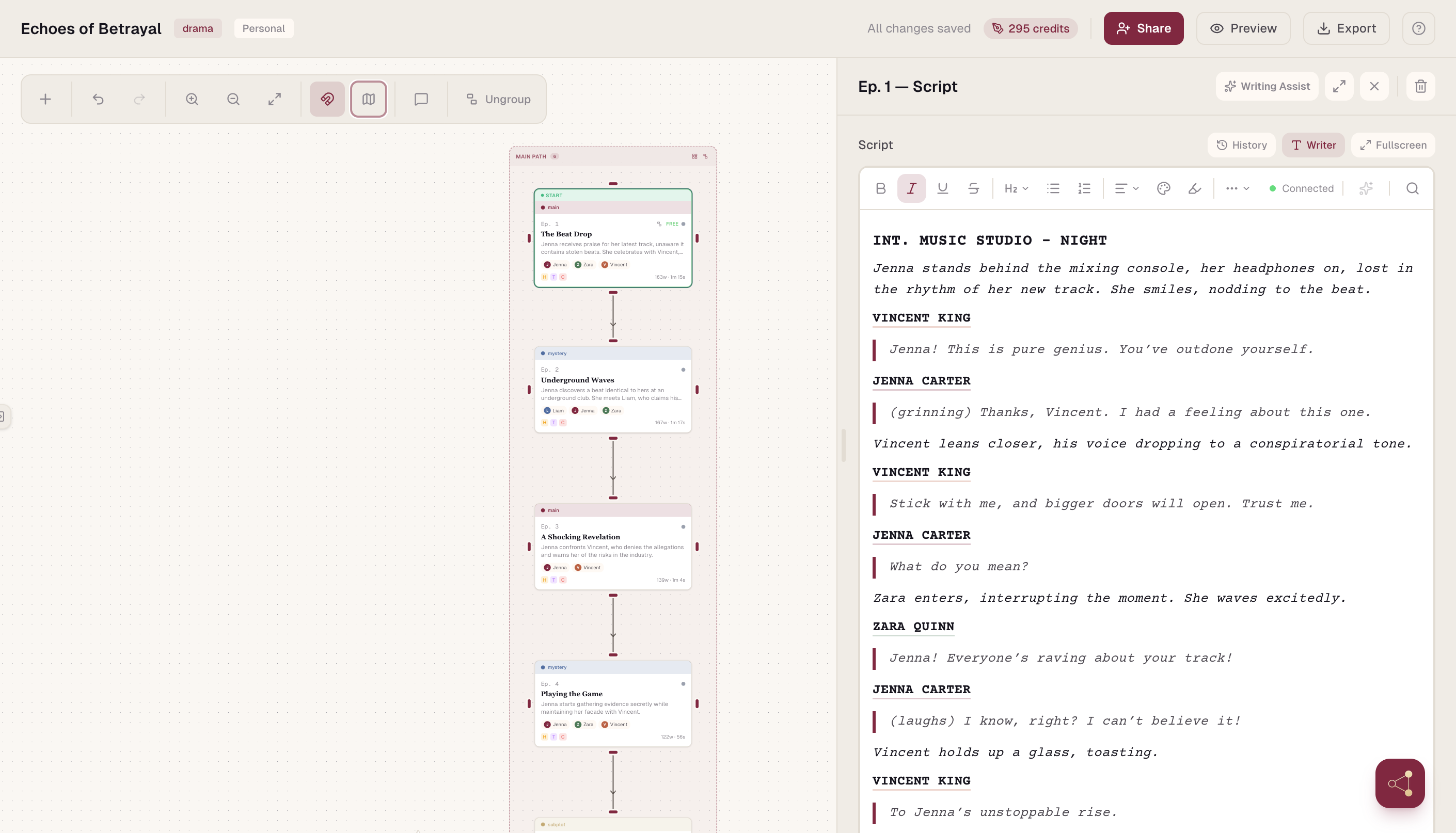
A useful platform should make it easy to move between high-level planning and scene-level execution. If a staff writer is shaping episode six, they should be able to see how that episode serves the wider arc. If a narrative designer is adjusting a branch, they should understand the script implications immediately.
Precise commenting
Inline feedback is far more useful than detached note threads because it keeps decision-making attached to the material. Search and filtering matter too. In a fast room, nobody wants to waste ten minutes finding where a note was left or which version introduced a scene.
Import and export
Rooms do not work in isolation. Material has to move in and out for producers, freelancers, script editors and production teams. Software that traps the work creates problems later, even if the writing experience feels polished upfront.
Visual structure
For episodic and branching work, this is not decorative. A node-based or map-based view can give a room immediate clarity on flow, dead ends, narrative density and pacing. The point is not to replace the script. It is to give the room a better lens for making story decisions before those decisions become expensive.
Why unified workflow beats stitched-together tools
There is a reason more creator-led teams are moving away from patched-together stacks. Unification changes the pace of development.
When the outline, story map, script and collaboration layer live together, writers make decisions faster because they can see consequences earlier. The room spends less time recapping context and more time solving actual story problems. Producers get clearer visibility. Revisions become easier to manage. And because the project structure is visible, new collaborators can onboard without slowing everyone else down.
This is especially useful for short-form serial production, where output expectations are high and turnaround windows are compressed. If your room is trying to build commercially sharp episodes for vertical platforms, there is very little margin for process drag. The software should help the room move with intent.
That does not mean every team needs the same setup. A two-person indie project may prioritise simplicity and affordability. A studio team may care more about permissions, handoff and scale. Some rooms need deep branching support. Others mainly need cleaner co-writing and tighter revision control. The right choice depends on format, team size and production pressure.
Where specialist tools pull ahead
General-purpose writing tools are fine when the project is simple. Specialist platforms pull ahead when the format itself creates complexity.
For branching vertical drama, the advantage of a purpose-built platform is not just convenience. It is accuracy. The software reflects the real shape of the work. Instead of forcing a non-linear story into a linear document workflow, it supports the way the room is already thinking.
That is where a platform like Scenvii makes sense. It is built around the actual development path of episodic, branching short-form drama: mapping story logic, drafting scripts, collaborating in real time, and moving material towards production without splitting the workflow across disconnected tools. For teams chasing both creative control and release speed, that alignment matters.
The best software disappears into the process
A writers' room should feel sharper because of the software, not busier. If the tool demands constant maintenance, endless manual sorting, or awkward workarounds, it becomes another producer to manage.
The strongest platforms fade into the background after setup. They make the current state of the project obvious. They reduce duplicated effort. They keep narrative decisions visible. They help the room stay inside the story while still operating like a serious production unit.
That is the standard worth using. Not just collaboration for its own sake, but collaboration that protects momentum.
Your next episode does not need another document. It needs a workspace that can keep up with the room writing it.