

How to Write Branching Dialogue for Vertical Drama on TikTok and Reels
A branching scene usually fails in one of two places. Either every choice sounds cosmetic, with different buttons leading to the same emotional beat, or the tree expands so fast that nobody can track what any character knows, wants, or hides. If you want to learn how to write branching dialogue, start there. Not with the software, not with the flowchart, but with the dramatic cost of choice.
Branching dialogue is not just linear dialogue with extra exits. It is a system of consequences written in character voice. That matters even more in short-form vertical drama, where scenes need to move fast, choices need to feel charged, and every branch has to justify its screen time. The audience will forgive complexity. They will not forgive filler.
How to write branching dialogue with real dramatic weight
The strongest branching dialogue starts with a scene objective, not a menu of options. Before you write a single line, decide what the scene is doing in story terms. Is the protagonist trying to win trust, conceal a betrayal, provoke jealousy, or test whether someone is lying? Once that objective is clear, the branches stop feeling random. They become different tactics aimed at the same dramatic target.
This is where many writers overbuild. They create choices based on surface behaviour (be nice, be rude, ask a question) without deciding what changes underneath. Better branching comes from defining the scene variables first. What can shift by the end of the exchange? Trust, suspicion, attraction, leverage, urgency, or information. If a branch changes none of those, it is probably decorative.
A useful test is simple: if the player or viewer picked a different line, what would the other character now believe? That answer should alter the next beat. Not necessarily the whole plot, but certainly the temperature of the scene.
Start from character strategy, not line variants
Good branches are not alternate phrasings of the same intent. They are alternate strategies.
Imagine a protagonist confronting an ex outside a hospital. One branch might use vulnerability: "I came because I thought you were alone." Another might use accusation: "You only called because you needed someone to blame." A third might use control: "We do this now, or I walk." Those are not stylistic swaps. They frame the relationship differently, invite different reactions, and create different downstream possibilities.
That is the level where branching gets interesting. Each option reveals character. Each response reshapes power.
The core structure behind branching dialogue
Most branching dialogue works best when you treat it as a sequence of decision beats, not an infinitely spreading tree. In production, especially for episodic short-form content, total freedom sounds exciting but quickly becomes expensive to write, review and shoot. What you need is controlled divergence.
A practical model looks like this:
- Begin with a shared setup
- Let the audience encounter a clear tension
- Offer a meaningful choice that changes the emotional approach or information flow
- Allow that choice to create a distinct response
- Where appropriate, fold branches back into a common scene endpoint with altered subtext, character state, or future flags
That last step matters. Branching does not always mean separate scenes forever. Sometimes the branch lives in memory, relationship value, or unlocked knowledge rather than a permanently split plot line. If every branch must produce entirely unique downstream content, scope balloons fast. If every branch collapses instantly with no residue, choices feel fake. The smart middle ground is persistent consequence with selective convergence.
Write for state changes
When writers struggle with non-linear dialogue, the real issue is often state management. They know what was said, but not what changed.
Treat each branch as an update to the scene state. After a choice, ask: what is now true?
- Perhaps the rival knows the hero is bluffing
- Perhaps the love interest is emotionally exposed but still withholding facts
- Perhaps the boss gives a deadline instead of an ultimatum because the conversation earned more patience
Once you write this way, later scenes become easier to manage. You are no longer chasing every line. You are tracking meaningful outcomes.
Keep each choice readable in the moment
A choice only feels powerful if the audience can read it quickly and predict its attitude, even if they cannot predict the exact consequence. This is especially important in mobile-first formats, where pacing is tight and cognitive load needs to stay low.
The common mistake is writing vague options such as "Push harder" or "Tell the truth" when the emotional direction is unclear. Strong branching choices are legible. They imply tone, risk and motive. The audience should understand the difference between reassuring someone, manipulating them, and baiting them into a confession.
At the same time, avoid overexplaining the result in the option text. If the choice says too much, the scene loses tension. The sweet spot is clarity of intent, not certainty of outcome.
Distinct choices need distinct voices
If three options sound like the same character wearing different hats, the branch will feel flat. Each option should preserve the speaker's core voice while expressing a different tactical version of that voice.
That means your hard-edged antihero does not suddenly become a therapist just because the scene needs an empathetic branch. Empathy, in that character's voice, may come out clipped, defensive, or awkward. A polished social manipulator might flirt, reassure and threaten with roughly the same syntax. Keep the voice consistent and let the strategy shift inside it.
Design branches around production reality
For creators building episodic vertical drama, the script is only part of the equation. Branching scenes need to survive table reads, revisions, collaboration, scheduling and handoff to production. That means your structure has to be visible.
If you are still writing branches in scattered documents or nested comments, you are increasing the chance of continuity errors and duplicated work. The cleaner approach is to map the interaction as nodes or connected beats, then write within that logic. It is easier to spot dead branches, repeated dialogue functions, and places where two supposedly different paths actually do the same job.
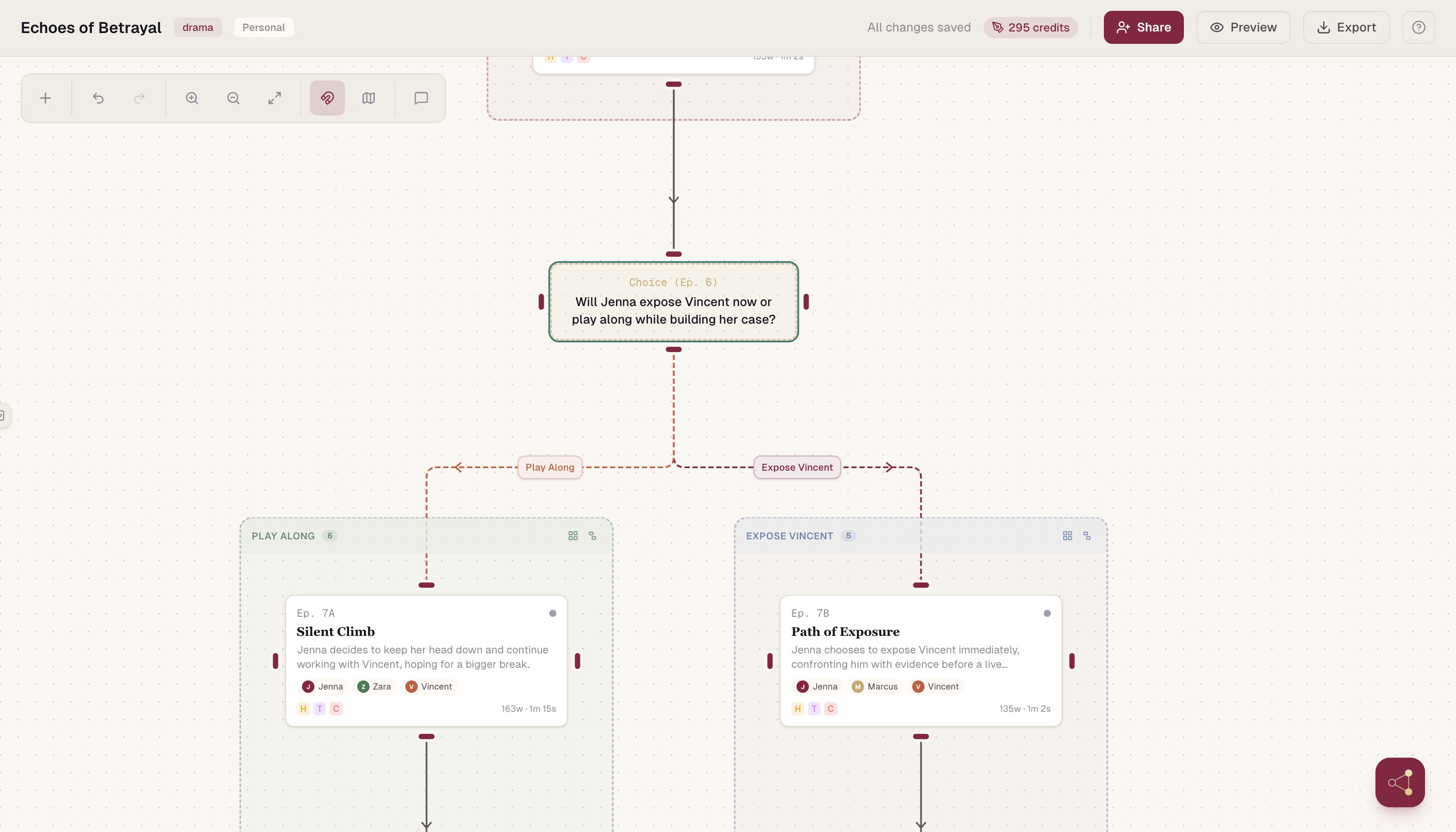
This is exactly why purpose-built development environments matter. In Scenvii, for example, writers can map branch logic and draft scene text within the same workspace, which cuts friction between planning and pages.
That workflow advantage is not abstract. It changes the quality of the writing because it lets you see structure while shaping performance.
How to avoid the branch explosion problem
The fear with branching dialogue is justified: every choice seems to multiply everything after it. But most branch explosions come from weak decision design, not from branching itself.
Do not offer a choice unless the scene can support a meaningful difference. More options are not better if they split attention without increasing drama. Two strong choices will usually outperform four thin ones.
Branch at pressure points. Choices should appear where the relationship, information, or power balance can plausibly change. If you insert choices every few lines, the scene becomes mechanical. If you place them at moments of tension, each branch carries weight.
Converge with intention. A branch can return to a shared scene path while preserving different emotional residue, unlocked knowledge, or future availability. Convergence is not cheating. It is structure.
The best branching dialogue feels inevitable afterwards
A useful benchmark is this: once the audience sees the result of a choice, it should feel surprising in the moment but obvious in hindsight. That comes from writing consequences that are rooted in character logic.
If one branch makes a character storm out, another makes them confess, and a third makes them laugh it off, those reactions all need to come from traits already established. Branching dialogue is not licence for arbitrary drama. It is a way to dramatise different pressures acting on the same person.
This is why subtext matters so much. Characters rarely respond only to the literal line. They respond to status threat, emotional timing, old wounds, and what the other person is trying to make them admit. When you write branches at that level, the dialogue starts to carry real charge.
A quick scene test before you lock it
Before you call a branching scene finished, read each path and ask four questions:
- Does this option reveal character?
- Does the response create a measurable state change?
- Does the branch justify its extra complexity?
- Does the scene remain watchable, not just interactive?
That last question is easy to miss. Branching dialogue is still drama. If a path works logically but plays flat on screen, rewrite it. Interactivity cannot rescue a weak scene.
The writers who get good at branching dialogue are rarely the ones with the biggest trees. They are the ones who understand scene design, emotional consequence and production constraints all at once. Write fewer branches, make them sharper, and let every choice change something the audience can feel. Your next scene should not just split. It should land.