

Node Based Story Mapping for Vertical Series and Interactive Drama
If your series lives or dies on choice, reveal timing and episode momentum, a linear outline starts breaking down fast. Node based story mapping gives branching drama a structure that behaves more like the story itself: modular, visual and built for consequences. For writers working in short-form serial, that is not a nice extra. It is the difference between controlling complexity and being buried by it.
Traditional outlining was built for a line. Branching vertical drama is not a line. It is a network of decisions, reversals, gated information and emotional pay-offs that have to land quickly on a mobile screen. When every episode needs propulsion and every branch needs logic, you need to see more than scenes in order. You need to see how narrative units connect, split and reconverge.
What node based story mapping actually changes
At a basic level, node based story mapping turns story beats, scenes, choices and outcomes into connected units. Each node holds a piece of the narrative. The links between them show dependency, progression and divergence. That sounds technical, but the creative gain is immediate: story structure becomes visible.
For episodic writers, that visibility matters because branching stories rarely fail from lack of ideas. They fail when the logic underneath the ideas becomes too difficult to track. A reveal gets repeated in one path and skipped in another. A character choice creates an emotional consequence in episode six, but only if the viewer saw a scene in episode two. A side branch becomes so expensive to maintain that the main arc starts losing pace.
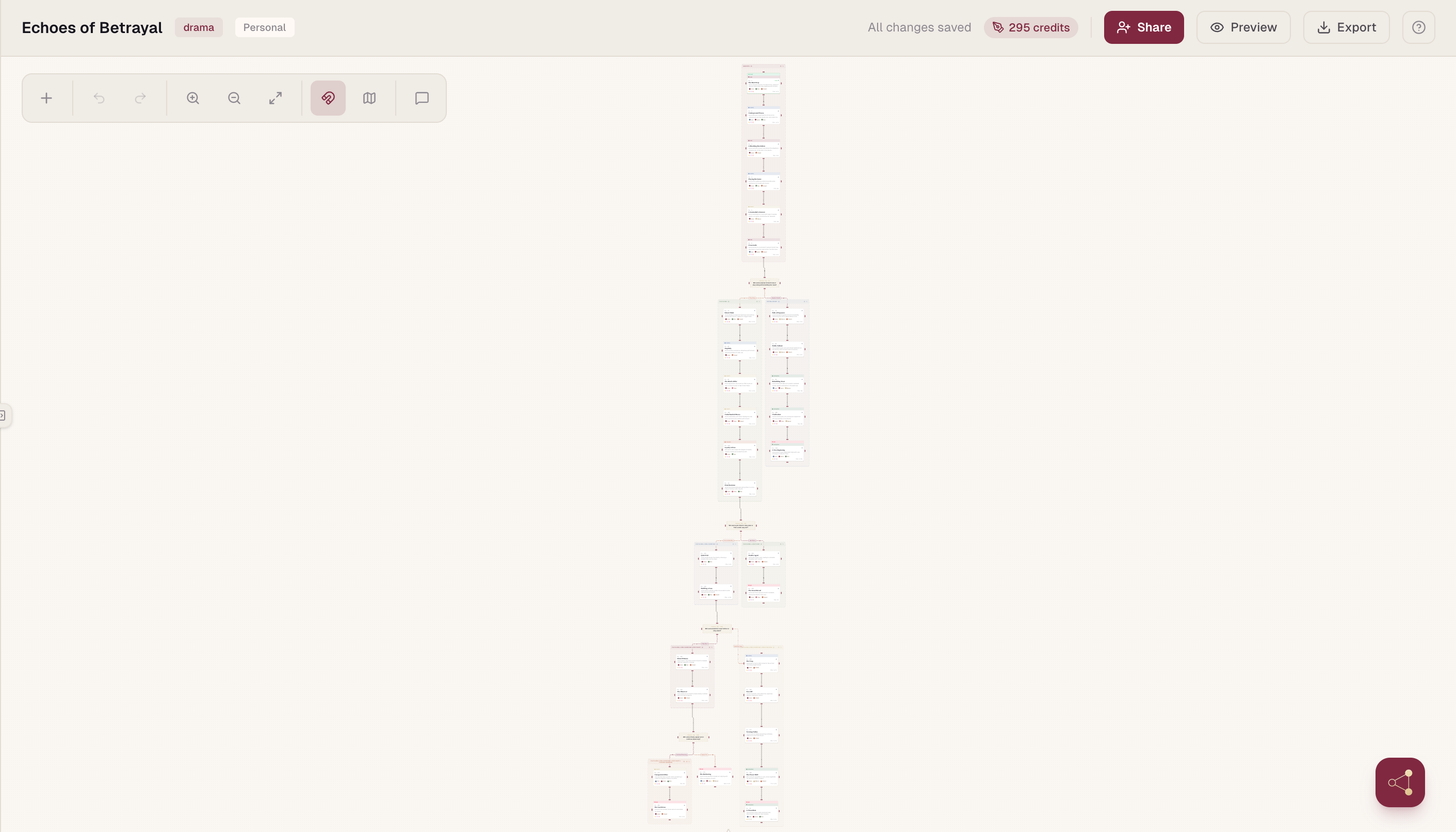
A node map brings those pressures into the open early. Instead of discovering structural problems after pages have been written, you can spot dead ends, thin branches and overloaded episodes while the material is still flexible.
Why branching short-form drama needs a visual system
Short-form vertical series have unusual structural demands. Episodes are compressed. Hooks need to hit almost immediately. Recaps, reveals and cliffhangers have to be engineered with precision. In branching formats, that pressure multiplies because every path still needs to feel intentional, not like leftover content.
This is where node based story mapping earns its place. It lets you design rhythm, not just sequence. You can see where branches happen, where they should collapse back into a shared spine, and where exclusive scenes genuinely add value rather than inflating the script. That is crucial in production-minded writing, because not every branch deserves equal screen time.
The strongest branching projects usually do not expand in every direction forever. They make selective promises. A choice matters here. A consequence lands there. A hidden route opens later. The map helps you protect those promises without turning the project into an impossible web.
Nodes are not just scenes
One of the biggest mistakes writers make is treating every node as a full scene by default. Sometimes that works. Often it does not.
In practice, a node can represent:
- A decision point
- A story beat
- An information gate
- A relationship turn
- A complete scripted scene
The right level depends on the stage of development. Early on, broader nodes keep the map readable and help you test branch logic quickly. Later, scene-level nodes become useful when pacing, dialogue flow and production planning start to matter. That flexibility is the real advantage. You are not locked into one storytelling granularity from day one.
The workflow problem most writers are really trying to fix
The appeal of node maps is not only visual clarity. It is workflow unification.
A lot of branching projects still get built across too many places: beat notes in one document, branching logic in a whiteboard, episode drafts in script software, feedback in comments and chat threads, version changes buried in duplicate files. The story may be ambitious, but the process is brittle.
That fragmentation creates creative drag:
- Writers lose time translating the same idea between formats
- Collaborators start working from different assumptions
- Structural changes become expensive because every update has to be copied into several tools
- The project slows down before it reaches production-ready shape
A production-oriented node based story mapping workflow removes that handoff problem. The map is not separate from the writing process. It becomes the architecture that the script grows out of. For teams building episodic, branching content at speed, that shift is operational as much as creative.
How to build a node based story map that stays usable
The best maps are readable under pressure. If yours only makes sense when you stare at it for twenty minutes, it is already too dense.
Start with the story spine
Identify the major emotional and commercial beats the series must deliver regardless of branch. In vertical drama, that usually means your opening hook, central premise escalation, key romantic or conflict reversals, reveal timing and episode-ending cliffhangers. These become anchor nodes.
Layer in meaningful branch points
Not every viewer choice or alternate action needs a new route. The strongest branch points change knowledge, relationship alignment, or immediate stakes. If a branch does not alter what the audience learns, feels, or expects, it may be variation rather than true branching.
Mark reconvergence deliberately
This is where many creators hesitate, as if bringing branches back together weakens the format. It does not. Reconvergence is often what makes branching drama sustainable. It lets you create consequence without multiplying production scope endlessly. The trick is making the return feel earned. A branch should leave residue: changed information, damaged trust, a different emotional register, even if the wider plot reconnects.
Keep three questions on every branch
When you add a branch, test it against three questions:
- What changes? If the answer is vague, the branch is weak.
- How long does that change matter? If the answer is one scene only, it may be better handled as flavour inside a shared path.
- What does it cost to maintain? If the answer is massive, the branch needs to justify itself commercially and creatively.
That is not about limiting ambition. It is about protecting the energy of the series.
Story logic is only half the job
A clean map can still produce flat episodes if you are not watching dramatic propulsion. Branching structure is not the same thing as drama.
Each node needs a reason to exist on screen. It should shift power, expose information, sharpen desire, or force a decision. If a node merely explains the route, it is doing admin, not storytelling. The audience can feel that instantly.
This matters even more in mobile-first formats, where attention is won scene by scene. Your map should help you check whether each path has momentum:
- Are there too many explanatory nodes before the next pay-off?
- Does one branch get all the best reveals while another feels like a holding pattern?
- Does a supposedly major choice lead to two emotionally similar outcomes?
Those are writing problems, but the map can surface them early.
Collaboration gets easier when the structure is visible
Branching projects rarely stay solo for long. Once editors, co-writers, producers, or development partners get involved, invisible structure becomes a liability.
Node based story mapping gives teams a shared language. A producer can assess scope. A co-writer can take ownership of a branch without losing sight of the whole. An editor can trace why a reveal must land before a later turn. The conversation becomes more precise because the architecture is visible.
That is especially useful in fast-moving studios and creator teams where iteration happens daily. Real-time visibility reduces the usual version-control mess. Instead of asking which draft contains the latest branch logic, the team can work from the same narrative framework while scripts evolve inside it.
That is one reason platforms like Scenvii feel increasingly relevant to modern episodic development: they reflect how branching stories are actually built, not how linear screenplays used to be managed.
Where node maps can go wrong
There is a trade-off here. The more detailed your map becomes, the easier it is to mistake planning for progress.
A beautiful graph does not guarantee a compelling script. Some writers over-map and under-write. Others become so focused on system logic that character behaviour starts feeling engineered instead of human. If every branch exists because it balances the chart, the audience will feel the machinery.
The fix is simple but not always easy. Use the map to clarify decisions, not replace them. Return to pages early. Test whether the emotional reality of a branch survives contact with dialogue, scene pressure and episode timing. If it does not, the map needs rewriting, not defending.
Node based story mapping is really about control
Not control in the rigid sense. Control in the production sense. Control over pace, branch value, team alignment and what the audience experiences at each turn.
That is why the method fits branching vertical drama so well. It respects the craft, but it also respects the realities of making serial content at speed. When story architecture, scripting and collaboration live in one connected process, you spend less time managing chaos and more time shaping the next episode people actually want to watch.
The strongest branching stories do not feel complicated for the sake of it. They feel intentional. A good node map helps you get there faster, with fewer blind spots, and with a clearer path from concept to production-ready script.
Your next turning point should not live in a spreadsheet.