

Short-Form Drama Scriptwriting App: Write for TikTok, Reels and Vertical Platforms
A phone-first episode lives or dies in seconds. If your opening beat lands late, if your choice logic breaks, or if your team is still chasing the latest draft in a folder called Final_v12, the audience is already gone.
That is why a vertical drama scriptwriting tool is not just a writing app with a trendy label. It needs to match the speed, structure and production reality of short-form serial storytelling.
Writers building for vertical platforms are not working inside the old television model. Longer runtimes, slower approvals, a single linear script that stays stable for weeks: that is not their world. They are shaping tight episode hooks, fast reversals, branching paths and commercially sharp character arcs designed for mobile viewing. The tool has to support that format from the first outline to the production handoff.
A vertical drama scriptwriting tool should think in episodes
Traditional screenwriting software usually assumes a feature, a half-hour pilot, or at best a conventional episodic workflow. Vertical drama works differently:
- Episodes are shorter, so every scene carries more weight
- Pacing is more compressed, and viewers can scroll away at any moment
- Season arcs still matter, but they need to be visible alongside individual episodes
A useful tool should let writers plan story at episode level without losing sight of the season arc. You need to see the hook in episode one, the reversal in episode three, the escalation around episode eight and the payoff later on, all without opening a dozen separate files and trying to hold the whole thing in your head.
If the workspace treats each episode as an isolated document, momentum drops. You start spending energy on navigation rather than story.
A purpose-built environment should make episode flow visible, editable and easy to reshape as the project evolves, especially when you are developing serial content under deadline.
Branching cannot be bolted on later
This is where many tools fall short. They handle dialogue well enough, but branching narrative is treated as an afterthought. For vertical drama teams building alternate paths, premium choices or variable character outcomes, that creates problems fast.
Branching stories are not only a writing challenge. They are a systems challenge. One choice affects:
- Scene order
- Emotional logic
- Character continuity
- Future episode load
If your tool cannot map those relationships clearly, your script becomes fragile. One revision in a later branch can quietly break something established much earlier.
Visual story mapping changes the writing process
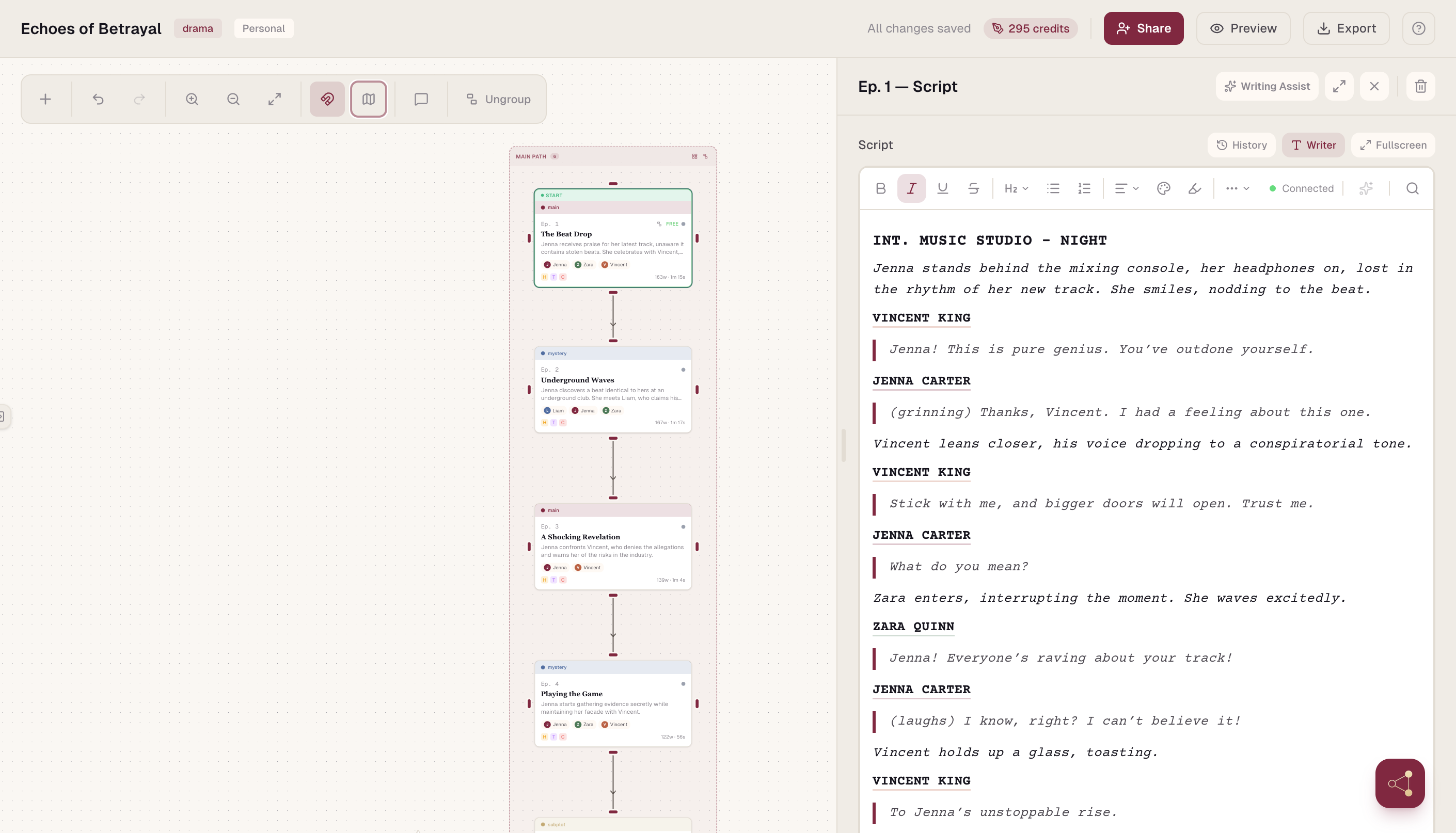
A node-based story editor is not a gimmick in this format. It gives writers a live view of narrative logic: where a viewer decision splits the story, where branches reconverge, and where emotional beats need to land regardless of path.
That has creative value, not just operational value. When writers can see structure, they make better decisions about tension, reveal timing and replayability. They stop writing in the dark and start shaping the audience journey with intention.
There is a trade-off, though. Visual mapping only helps if it is integrated with the script itself. If the map sits in one product and the pages live somewhere else, you have simply created another layer to maintain.
The strongest setup is one workspace where structure and script inform each other in real time.
The writing interface still has to respect the craft
A modern production tool can look sharp and still fail writers if the drafting experience feels clumsy. Vertical drama moves quickly, but speed should not come at the cost of rhythm, dialogue flow or scene control.
The script editor needs to be:
- Fast: no lag between thought and text
- Clean: intuitive formatting and scene management
- Low-friction: seamless movement between planning and drafting
If a writer has to fight the interface every time they adjust a beat or move a scene, they will work around the tool instead of inside it.
For mobile-first serial storytelling, the editor should also support the realities of short scenes and dense cliffhanger pacing. A vertical drama episode often contains more turn points per minute than traditional television. The software should make it simple to track those turns and keep energy high across a run of episodes.
Collaboration should happen inside the work, not around it
Most script problems in teams are not about talent. They are about version control:
- Notes arrive in chats
- Rewrites sit in separate documents
- Producers review one draft while the writer has already changed another
- By the time anyone notices, the script status is unclear and trust in the process starts to slip
A vertical drama scriptwriting tool should keep collaboration close to the material itself. Real-time editing, comments in context and shared visibility across story maps and script pages save more than time. They reduce confusion at the exact stage where projects usually become expensive.
This is especially important for indie teams and writer-led studios. Smaller teams move fast, but they also have less margin for operational mess. A unified workspace lets them act bigger than they are because everyone can see the same project state at once.
Import and export are not side features
No serious production pipeline begins and ends in one perfect app. Writers may arrive with material from another screenplay platform. Producers may need files in formats their downstream teams already use. Development may happen in one rhythm, while production requires another.
That means import and export are core workflow features, not optional extras. A tool that traps your script inside its own system will eventually create resistance, especially for teams juggling clients, external partners or legacy documents.
At the same time, flexibility should not mean disorder. The best vertical drama software lets you:
- Bring existing work in from other formats
- Develop it properly in a structured environment
- Send it out cleanly when the next stage begins
It respects how production actually works.
Production visibility is part of the writing job now
Writers in this space are not only delivering pages. They are shaping a product for a very specific market. Mobile-first audiences respond to pace, emotional clarity, reveal timing and serial compulsion.
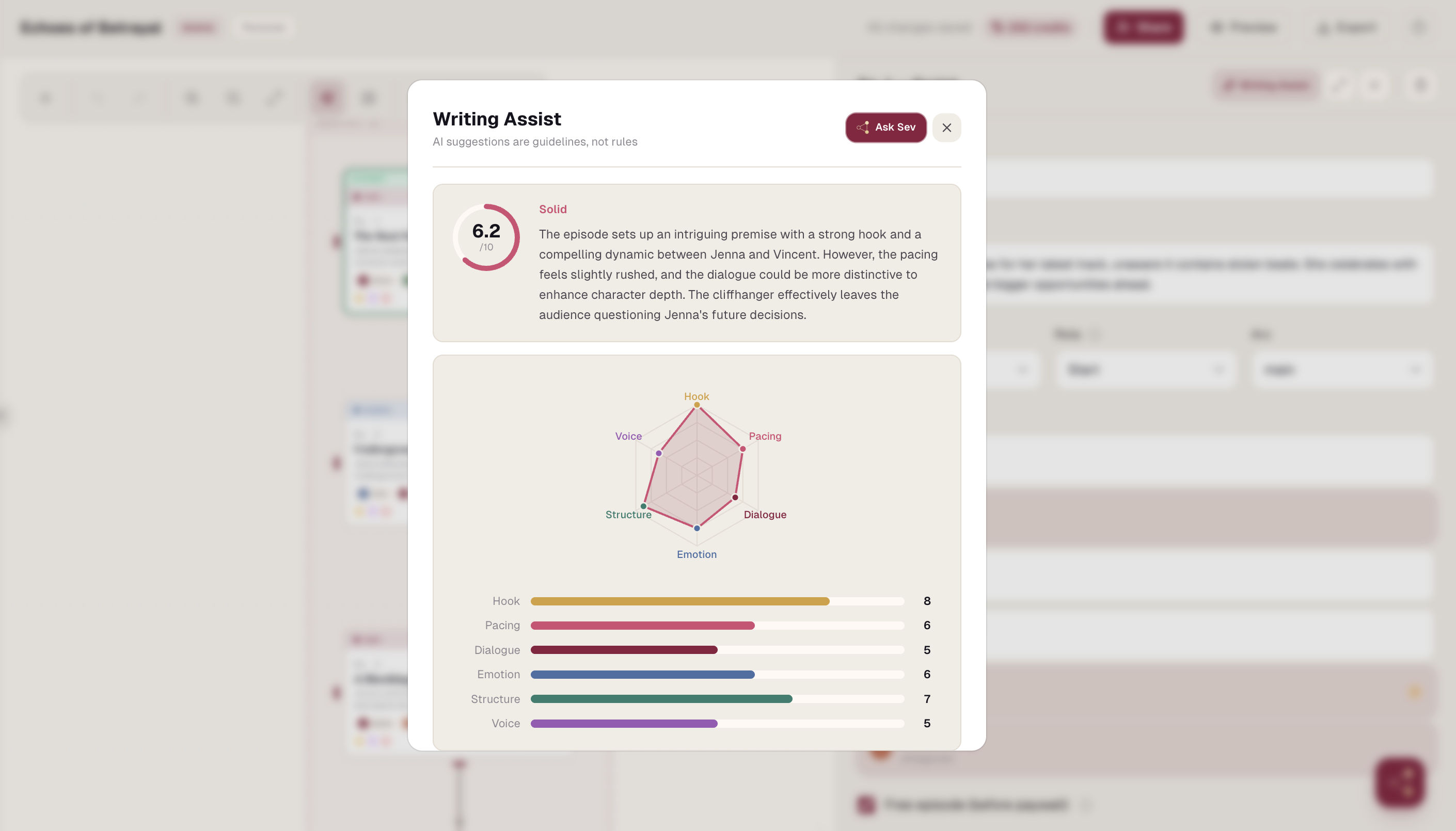
That does not mean turning writing into pure analytics. It means giving creators a clearer operating view:
- Can you see the branch load before it becomes unmanageable?
- Can you identify where an episode slows down?
- Can collaborators track what changed and why?
- Can the team move from concept to production-ready script without rebuilding the project in three other places?
These questions matter because the market is moving quickly. The audience is already there. The teams that win are often the ones with the cleaner workflow, not just the stronger premise.
Why generic script apps feel slow in a fast format
Plenty of general screenwriting tools can produce a formatted script. That is not the same as supporting vertical drama development. A generic app may be perfectly fine for linear features or standard pilots, but this format asks for more connected thinking:
- Story mapping tied to script pages
- Branching logic that stays readable
- Episode-level visibility across a serial arc
- Collaboration that does not depend on exported files bouncing around by post
And all of it without bloating the writing process.
That last part is worth stressing. More features are not automatically better. A tool for this category should feel production-oriented, not overbuilt. If every action requires a setup phase, writers lose pace. If the software is too narrow, teams outgrow it. The sweet spot is a system designed for the actual workload of branching short-form drama.
Scenvii sits in that lane because it is built around workflow unification rather than generic screenwriting. That distinction matters when your project needs outlining, branching, drafting and team coordination to happen in one production-ready environment.
The best vertical drama scriptwriting tool reduces friction at every stage
When people talk about writing software, they often focus on features in isolation: a visual editor here, comments there, import somewhere else. In practice, what creators feel day to day is friction:
- How many times do you have to switch tools?
- How often do you lose context?
- How difficult is it to trace a change from story plan to final scene?
A strong vertical drama scriptwriting tool reduces those breakpoints. It lets you sketch the story, test the branch logic, draft the episode, review changes with the team and prepare for handoff, all without fragmenting the project. That does not just make the process tidier. It protects creative momentum.
And momentum is the real asset in short-form serial work. When a story is moving, teams can feel it. Episodes stack faster, revisions get smarter, and production decisions become easier because the underlying narrative is visible and coherent.
If you are building for vertical platforms, choose a tool that understands the format at the level of structure, not just style. The right workspace will not write the cliffhanger for you, but it will give that cliffhanger a better chance of reaching the screen exactly as intended.