

TikTok Branching Story Tool: Software for Choice-Driven Vertical Drama
A branching story usually breaks long before the script does. Not on page 40, but in the gap between a whiteboard, a beat sheet, a draft folder and a dozen messages about which version is current.
That is exactly where branching narrative software earns its place, not as a nice extra, but as the system that keeps choice-driven storytelling coherent when episodes, paths and team input start multiplying.
For writers and studios building short-form serial drama, that pressure arrives early. One decision creates three outcomes. Each outcome needs emotional continuity, production logic and a reason to exist. When you are working in vertical episodic formats, the pace is faster, the hooks are sharper and the margin for confusion is smaller.
The tool you choose shapes more than organisation. It shapes whether the story can actually be made.
What branching narrative software should really do
A lot of software can claim to support non-linear storytelling. Far fewer tools are built around how writers actually develop branching drama. The difference matters.
Good branching narrative software does not just let you draw connections between scenes. It helps you:
- See narrative consequences across paths and episodes
- Track decision points that ripple through downstream scenes
- Keep episode flow legible as the story expands
A visual map is useful, but only if it stays tied to the script itself. If your structure lives in one platform and your draft lives in another, you have not solved the problem. You have simply made it look tidier.
The real test: Can the software hold story logic and scriptwriting in the same working environment? Can a writer move from plotting a branch to drafting the scene without breaking concentration? Can collaborators comment, revise and follow the latest structure without chasing files?
If not, the workflow still fragments under pressure. And for short-form teams, that is where purpose-built tools pull ahead of general writing apps. A branching series is not just a screenplay with extra paths. It is a system of scenes, outcomes, reversals and pacing beats that has to stay readable from concept through production.
Why generic writing tools fall short
Traditional screenwriting software is built for linear progression. One page follows the next. One script version replaces the last. That works for a feature, a pilot or a standard episodic script. It starts to strain when narrative design becomes part of the writing process.
You can force a branching project into a linear tool. Many writers do, with separate docs, colour-coded spreadsheets, external boards and naming conventions held together by memory. It works for a while, especially on smaller projects or solo drafts.
But once the story branches in earnest, friction appears everywhere:
- Version control becomes messy
- Structural changes stop syncing with the draft
- Team members lose visibility
- Producers struggle to understand what changed and why
- Writers spend more time managing the story than writing it
That trade-off is easy to underestimate. People often think the main challenge of branching drama is creativity: keeping choices interesting, preserving stakes, avoiding repetitive scenes. Those are real craft issues, but the operational issue is just as decisive.
If the workflow cannot support complexity, the creative ambition gets cut back to fit the tool.
The features that matter most
The strongest branching narrative software is not the one with the longest feature list. It is the one that reduces drag at the exact points where branching projects usually slow down.
Visual node-based editing
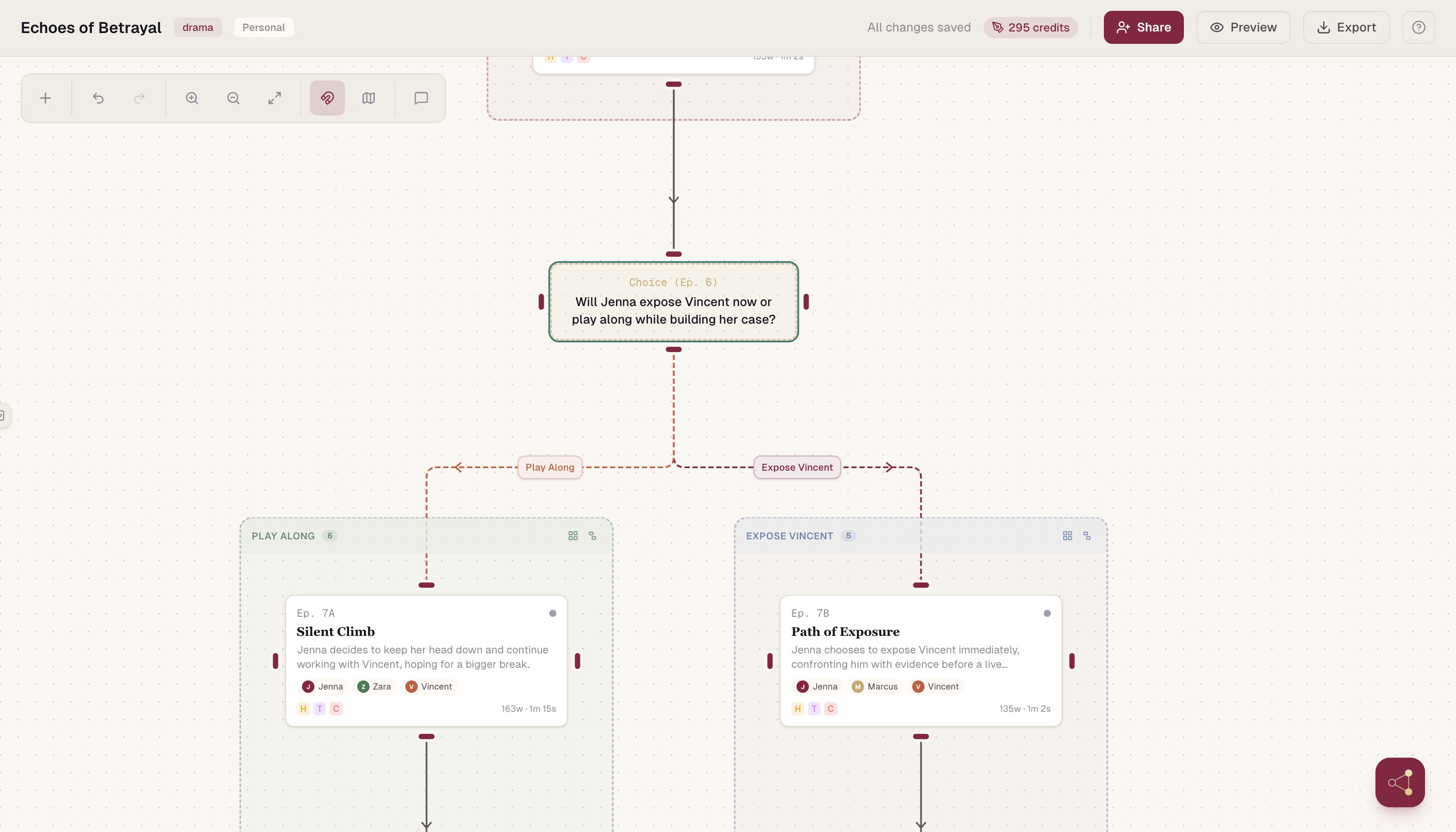
Gives writers and creative leads a live view of how scenes connect, where paths split and where narrative threads rejoin. But the visual layer needs to be more than presentation. It should function as a working story map, not a static diagram built for a pitch deck.
Inline scriptwriting
When a scene node opens directly into the writing space, the structure stops feeling separate from the script. That saves time, but more importantly it preserves narrative intent. You are drafting from the branch logic itself, not reconstructing it from notes.
Real-time collaboration
Branching projects generate more questions than linear ones. Which path is canon for this version? Does this choice alter the next episode's opening? Has this branch been approved, revised or cut? A shared workspace keeps those answers visible.
Import and export
Writers rarely build a project from a blank, isolated start. There are treatment docs, existing scripts, scene outlines and production handoff requirements. Software that cannot move material in and out cleanly becomes a bottleneck, especially when the project starts leaving development and heading towards production.
Branching narrative software for vertical drama
This is where context changes the decision. Software that works for a narrative game team is not automatically right for episodic vertical drama. The form is different. The rhythm is different. The production demands are different.
Mobile-first serial storytelling relies on compression:
- Every scene has to land quickly
- Every branch has to justify its screen time
- Episodes need strong endings, clean transitions and enough clarity that a viewer can follow the emotional logic without feeling the machinery behind it
That means branching narrative software for this space should support speed without flattening complexity. Writers need to map paths clearly but move fast enough to keep momentum. Producers need visibility across episodes but not at the cost of turning the writing process into project administration.
A platform like Scenvii makes sense in that environment because it is built around the actual workflow of branching short-form drama, rather than adapting a generic script tool after the fact. That distinction is practical, not cosmetic. It means story mapping, drafting and collaboration are treated as one creative-production system.
How to evaluate a tool without wasting weeks
The fastest way to choose badly is to focus on demos over workflow. Most tools look good in a controlled walkthrough. The better question is: what happens on day six, when the branching map has doubled, the episode order has shifted and three people are editing at once?
Start with your own process
- Are you primarily outlining first, then drafting?
- Are you writing branches scene by scene?
- Do you need producers, co-writers or development executives inside the same workspace?
The answers will change what matters most.
Test for friction
Create a small branching project with at least two major choice points and several downstream scenes. Then:
- Move between outlining and drafting
- Make structural revisions
- Invite another collaborator
- Export material for handoff
That sample will reveal more than any feature page.
Check readability at scale
Plenty of tools feel clean on a tiny map. The real question is whether the structure remains understandable when the project reflects an actual series, not a proof of concept.
Consider the real cost
Free or low-cost software can be sensible for solo experimentation. For an active team, the larger expense is usually time lost to workarounds. If people are rebuilding structure manually, cross-checking versions or reformatting material for handoff, the cheapest tool may be the most expensive one in practice.
The trade-off between flexibility and control
No platform solves every storytelling problem. Branching narrative software can clarify structure, speed up drafting and reduce chaos. It cannot make weak choices compelling or fix a branch that exists only because the map had room for it.
There is a real balance between flexibility and discipline. Some writers want infinite freedom at the ideation stage. Others need tighter systems to keep projects commercially viable. The best software does not force one philosophy. It supports exploration while still making the story legible enough to refine, share and produce.
That is especially important for writer-led studios and indie teams. You are not building branches for their own sake. You are shaping a story engine that can survive notes, revisions, deadlines and market realities. A good tool helps protect the ambition by giving it structure.
Where the category is heading
Branching storytelling is no longer a niche workflow reserved for experimental projects. It is becoming part of how modern serial content gets developed, tested and packaged for audiences who expect pace, interactivity and repeat engagement.
The audience is already there. The production process is catching up.
That shift will reward software built around the realities of narrative production, not just abstract story design. Writers need environments that understand episode flow, collaborative development and the operational mess that appears when a project starts moving quickly.
The next generation of branching narrative software will not win on novelty. It will win on whether it lets creators think clearly, write quickly and keep the whole story visible.
If your current setup makes branching drama feel harder than the story itself, that is your signal. The right tool should not ask you to shrink the idea to fit the workflow. It should give the idea room to become production-ready.